Tracking stories Arizona State University would rather you scrolled past. Every item links to its original reporting.
Crime Watch from ASU Police and federal Clery reports
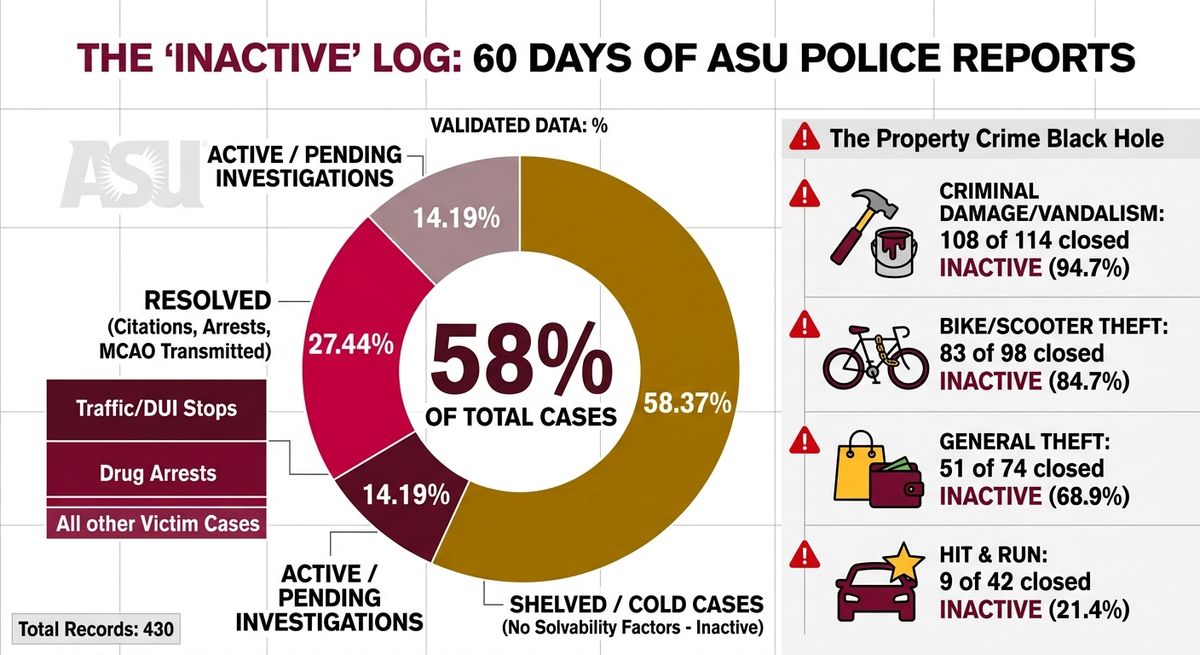
430
ASU Police cases logged Aug. 14 – Oct. 13, 2026
8
reports of sexual assault or sexual abuse in those 60 days
234
log entries closed as "No Solvability Factors (Inactive)"
59
bike, e-bike and scooter thefts reported
Violent crime reported on campus, 2014–2024
RapeAggravated assault
All ASU campuses, on-campus locations, as reported to the U.S. Department of Education. Reports, not convictions. Source data · ASU crime logs
Just off campus: Tempe Police, last 60 days
ASU Police cover campus property. The streets, apartments and party houses around it belong to Tempe Police. This panel pulls Tempe's public offense data for the Rio Salado / Downtown / ASU / NW neighborhoods area, live, each time the page loads.
Loading Tempe Police data…
Why Tempe's numbers matterA Tempe Police crime-analysis case study says the city's daytime population swells from about 175,000 to nearly 245,000 largely because of ASU, and names loud parties, underage drinking, sexual assaults and fights as university-town problems. In 2015 Tempe's index crime rate was 4,899.9 per 100,000 residents, against 3,374.8 for Arizona. Tempe Police also supply the off-campus crime statistics ASU uses in its federal Clery reports.
Source: Tempe Police Department, Case Study: Crime Analysis Capability Project (FBI-era figures through 2015).
How to read thisCase-level details stay off this site to protect victims. "No solvability" is a routine status, most common for thefts and vandalism with no witness or suspect. Rising report counts can reflect more survivors coming forward as well as more crime. Both deserve answers from ASU.
ASU Police's own Clery 60-day log (Aug. 14 to Oct. 13, 2026) lists 430 cases, including 8 reports of sexual assault or sexual abuse, about 20 assaults and fights, and 59 bike, e-bike and scooter thefts. 234 entries are marked "No Solvability Factors (Inactive)," meaning police found no leads to pursue.
A State Press investigation found ASU recorded 68 rapes from 2017 to 2019. Of the 11 cases ASU Police referred to the county attorney, all 11 were refused. Since 2014, 277 sexual assaults were reported to the university, 147 were investigated, and fewer than half of the 101 formal cases could have ended in punishment.
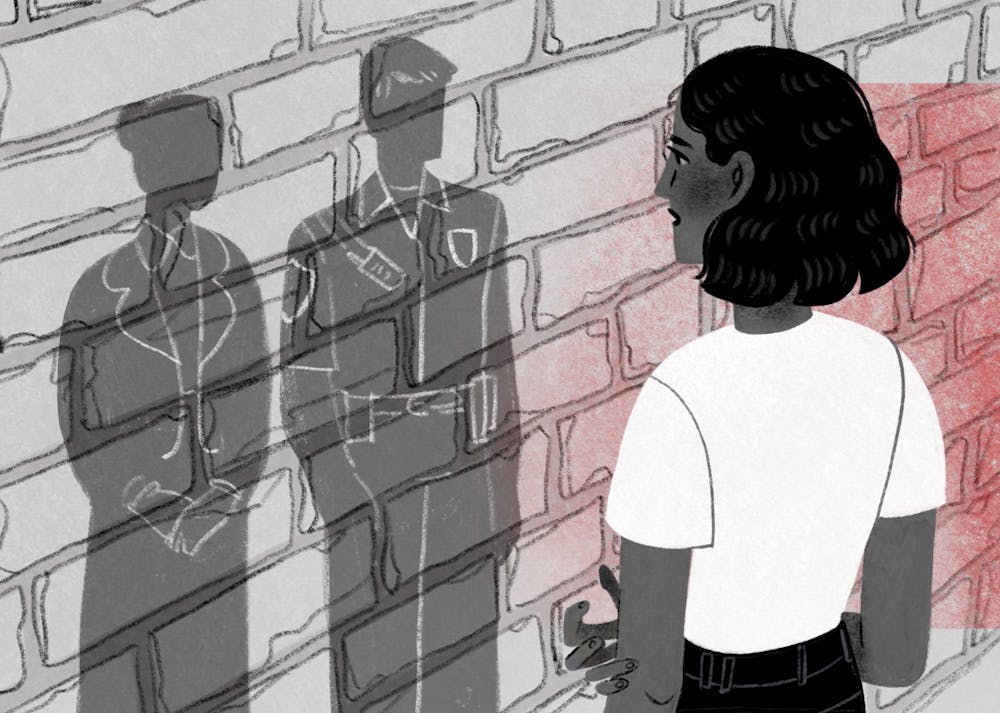
The U.S. Department of Education found ASU violated federal law by requiring a student who reported a rape in February 2020 to sign a nondisclosure agreement before she could see the written findings of her disciplinary hearing. The notice also gave no clear reasoning for the outcome and didn't mention her right to appeal.